Leadership does not develop in isolated training sessions, but in real situations: in conversations, in conflicts, in decisions, in moments of pressure. Frauke: "Learning journeys start exactly there and connect reflection, feedback, and experimentation in a way that turns insight into new behavior."
What are learning journeys?
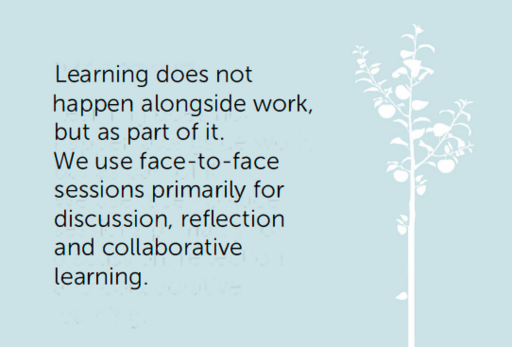
"Learning journeys bring learning in organizations to the point where it truly creates impact — in day-to-day work, in behavior, and in results. Many of the learning journeys I have designed and facilitated in recent years focus on leadership — in SMEs, NGOs, corporations, and agencies. They are aimed at new managers, experienced leaders, or sometimes framed around a very specific question (for example, for women): Is leadership (also) my path?"
What does that look like in practice?
"Depending on the goal and the context, every journey is a little different. One principle always remains: we orient ourselves around key situations (aka “moments of truth”). With these situations in mind, participants define their own focus. Feedback from supervisors and the surrounding environment helps support that process."
Learning journeys follow a clear didactic arc, usually over 8–10 months: each phase builds on the previous one and only becomes truly effective because of that.
This is what a journey can look like (pdf):
- Check-in: What is this about, how is it going, who is involved? (2 weeks)
- Essence: Who am I as a person and as a leader? (4-6 weeks)
- Aspiration: Who do I want to be as a leader? What is my ambition? (1 week)
- Experiments: What do I want to try differently in my day-to-day work? (3 months)
- Mastery: What has proven effective, and what do I want to focus on until the end? (3 months)
- Harvest: What am I taking away, what are we celebrating, and what comes next? (2 weeks)
Curious how a learning journey could look in your organization?
We’d be happy to explore it together.